

A summary of RESNET/ACCA/ANSI Standard 310 for HVAC systems compliance.
Any duct system can meet the grading requirements of RESNET Standard 310, but Rheia systems can help to meet them more quickly and consistently. In this article, we delve into the details of RESNET/ACCA/ANSI Standard 310, as it relates to HVAC requirements.
There are five steps per the Standard 310 Grading Process:
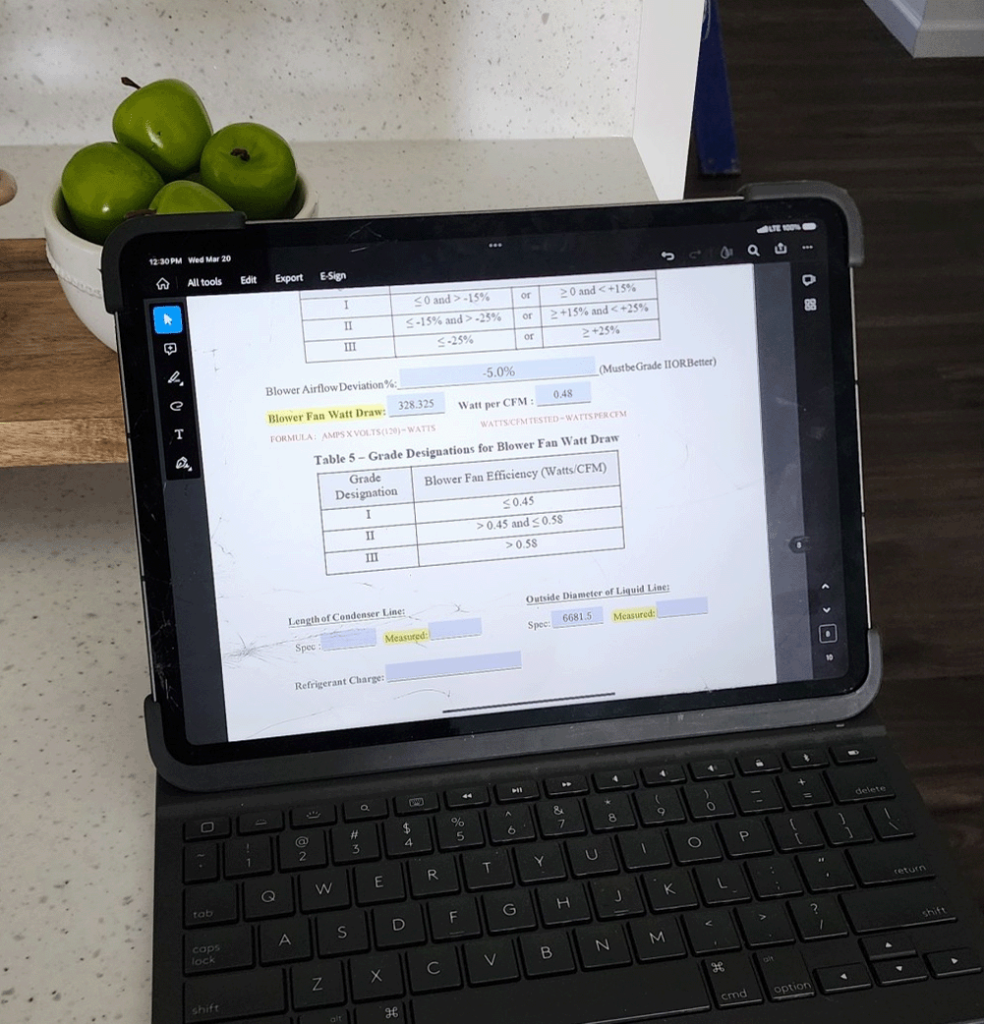
HVAC System Design Evaluation: The Rheia design process is based on ACCA Manual J, ACCA Manual S, and ANSI Standards. Reports are provided for each Rheia design that includes the following information, making it easy for evaluators to provide a Grade I score for all Rheia designs.
- A design report should be completed to assess the design and installation accuracy per Sections 4.1-4.31.
- Section 4.2 confirms that all necessary information for completing heat loss calculations is collected.
- Section 4.3 requires the designer to adhere to architectural plans and building specifications and define AHRI-rated equipment.
Measurement of Total Duct Leakage: Conventional ductwork can be sealed to meet Grade I or II requirements but relies on contractors to tape and mastic joints to achieve high-quality seams. Because of the labor and skill required to seal conventional ductwork with mastic, conventional ductwork has inconsistent leakage results, often requiring more than one attempt to seal all connections well enough to meet the leakage requirements. Rheia systems self-seal easily and have met Grade I leakage requirements with no known exceptions. A Grade I installation meets these requirement
Standard 310 Table 2a: Duct Leakage Limits for Grade I (IP)
| Time of Test | # of Returns | Leakage Limit (CFM at 25 Pa) |
|---|---|---|
| Rough-In | <3 | The greater of ≤ 4 per 100 ft2 of CFA or ≤ 40 |
| Rough-In | ≥3 | The greater of ≤ 6 per 100 ft2 of CFA or ≤ 60 |
| Final | <3 | The greater of ≤ 8 per 100 ft2 of CFA or ≤ 80 |
| Final | ≥3 | The greater of ≤ 12 per 100 ft2 of CFA or ≤ 120 |
Standard 310 Table 3a: Duct Leakage Limits for Grade II (IP)
| Time of Test | # of Returns | Leakage Limit (CFM at 25 Pa) |
|---|---|---|
| Rough-In | <3 | The greater of ≤ 6 per 100 ft2 of CFA or ≤ 60 |
| Rough-In | ≥3 | The greater of ≤ 8 per 100 ft2 of CFA or ≤ 80 |
| Final | <3 | The greater of ≤ 10 per 100 ft2 of CFA or ≤ 100 |
| Final | ≥3 | The greater of ≤ 14 per 100 ft2 of CFA or ≤ 140 |
Measurement of System Airflow: Meeting Grade I or Grade II requirements will depend on the correct fan speed, correct air handler functioning, and total external static pressure near the design static pressure. Rheia systems are more consistently near the design static pressure than conventional ductwork. The home run configuration and engineered components result in more predictable static pressure. The Rheia Verify process helps ensure the installed system meets the design.
Standard 310 Table 4: Grade Designations for Blower Fan Volumetric Airflow
| Grade Designation | FAF Range | ||
|---|---|---|---|
| I | ≤ 0 and > -15% | or | ≥ 0 and < 15% |
| II | ≤ -15% and > -25% | or | ≤ 15% and <25% |
| III | ≤ -25% | or | ≥25% |
Measurement of Fan Watts Per CFM: Meeting Grade I or Grade II requirements will be based on using an efficient air handler and duct system static pressure within the manufacturer’s accepted range. See the previous point about Rheia’s advantage in duct system static pressure.
Standard 310 Table 5: Grade Designations for Blower Fan Watt Draw
| Grade Designation | Blower Fan Efficiency (Watts/ CFM) |
|---|---|
| I | ≤ 0.45 |
| II | > 0.45 and ≤ 0.58 |
| III | > 0.58 |
Measurement of Refrigerant Charge: A prerequisite for measuring refrigerant charge is that the Measurement of System Airflow must meet Grade I or Grade II requirements. See Measurement of Fan Watts Per CFM above on how Rheia can help meet system airflow requirements. The startup technician must then meet the criteria for the refrigerant charge.
Compliance Requirements
To comply with ANSI/RESNET/ACCA Standard 310, an HVAC contractor must follow several steps to ensure the HVAC systems they install or grade will meet the requirements in the standard. The steps enhance the energy efficiency and overall performance of HVAC systems through rigorous grading and installation practices. Here’s an overview of what an HVAC contractor needs to do:
- Undergo Training: HVAC contractors and Home Energy Raters and Rating Field Inspectors must complete mandatory training specific to Standard 310. This training consists of online modules that cover the standard’s requirements in depth. The total duration of these modules is approximately 4.5 hours, completed at the individual’s own pace. The training requirement also applies to the Quality Assurance Designees who perform QA reviews on any ratings that show credit for HVAC grading.
- Pass a Graded Field Evaluation: After completing the online training modules, the contractor must pass a Graded Field Evaluation. This evaluation, approved by a Quality Assurance Designee (QAD), assesses the contractor’s ability to practically apply the standard.
- Use Updated and Accredited Software Tools: For HVAC grading under Standard 310, contractors must use up-to-date and accredited software tools to reflect the new standard. These tools are essential for accurately grading HVAC installations and ensuring they meet the requirements of Standard 310. Raters may not use software accredited with ANSI/RESNET/ICC 301-2014 to show credit for HVAC grading.
- Adhere to Specific Grading Criteria: The standard sets forth specific criteria for grading the installation quality of HVAC systems. Contractors must be familiar with these criteria and ensure that the HVAC systems they install or grade meet or exceed the established benchmarks.
Achieving the grade levels of Standard 310
Achieving different grade levels in the ANSI/RESNET/ACCA Standard 310 directly impacts the HERS Index Scores. Achieving a Grade I installation can reduce HERS Index Scores by as much as 6 points, depending on the climate zone. This reduction is significant as it can qualify homes for the federal 45L tax credit for energy-efficient homes, providing a substantial incentive for high-grade installations.
Compliance with Standard 310 can lower a home’s HERS Index score, with entire Grade I compliance estimated to reduce the score by an average of 5 points nationally. This grading process evaluates the HVAC system design, total duct leakage, system airflow, fan watts per cfm, and refrigerant charge.
The HERS Index Score reduction potential highlights the importance of striving for Grade I installations, not only for the energy efficiency benefits but also for the financial incentives available to builders.
Compliance with Standard 310 can lower a home’s HERS Index score, with entire Grade I compliance estimated to reduce the score by an average of 5 points nationally. This grading process evaluates the HVAC system design, total duct leakage, system airflow, fan watts per cfm, and refrigerant charge.
The HERS Index Score reduction potential highlights the importance of striving for Grade I installations, not only for the energy efficiency benefits but also for the financial incentives available to builders.
Some of Standard 310’s installation requirements are more demanding than those that HVAC contractors typically comply with today. The builder will need to assess the capabilities of the contractor installing the HVAC systems to ensure they can consistently meet the duct leakage, total system airflow, and fan watt draw requirements in Standard 310. Failure to achieve the Standard will result in costly rework and retesting. Rheia can help make some of the items more accessible to meet consistently.
- Rheia mandates that all its designs include Manual J, Manual S, and duct reports to ensure they meet requirements.
- Rheia’s ductwork has a self-sealing capability that consistently meets Grade I leakage standards, while conventional ductwork’s leakage results vary due to the dependency on contractor sealing techniques.
- Due to their predictable home run configuration and the Rheia Verify process, Rheia systems are more likely to maintain design static pressure, aiding in consistently meeting Grade I or II airflow requirements,
- Rheia and conventional systems must use an efficient air handler and maintain appropriate static pressure to meet fan-watt draw requirements.
- Fan watt draw is more accessible with Rheia because a static pressure measurement is required when balancing the home.
- For the refrigerant charge to be measured, total system airflow must meet Grade I or Grade II requirements because the total airflow impacts the validity of the refrigerant charge. Rheia can help meet the total system airflow requirements more consistently than conventional ductwork.
In conclusion, adhering to ANSI/RESNET/ACCA Standard 310 is beneficial for HVAC contractors to ensure that the systems they install or grade meet the required standards. While conventional HVAC systems can meet the grading requirements, using Rheia can significantly expedite and streamline the process, helping professionals and business owners achieve compliance more efficiently and consistently. If you liked this post, you might find this article about the changes to Energy Star Compliance and its impact on HVAC useful too.
References
https://www.resnet.us/wp-content/uploads/310-HVAC-Design-Report-v3-2021-01-05_clean_Fillable.pdf
https://www.resnet.us/articles/ansi-resnet-acca-310-implementation-of-hvac-grading/
https://codes.iccsafe.org/content/ICC3102020P1#:~:text=URL%3A%20https%3A%2F%2Fcodes,100
https://www.resnet.us/articles/ansi-resnet-acca-310-implementation-of-hvac-grading/


